
Is It Time to Upgrade Your Accounting?
Upgrading your accounting is not only about buying newer software. A real upgrade shows up in three places: the systems you run your books on, how you keep your records through the year, and whether you actually read the reports those books produce. Most small business owners only touch their accounting once a year, right before a tax deadline. The ones who pull ahead treat it as a tool they use every month. Here is how to tell which side you are on, and whether you are due for an upgrade.
Outgrown your current setup?
If the books are eating your evenings or you’re not sure the numbers are right, we can tell you where the gaps are in one short call.
Signs you’ve outgrown your current bookkeeping
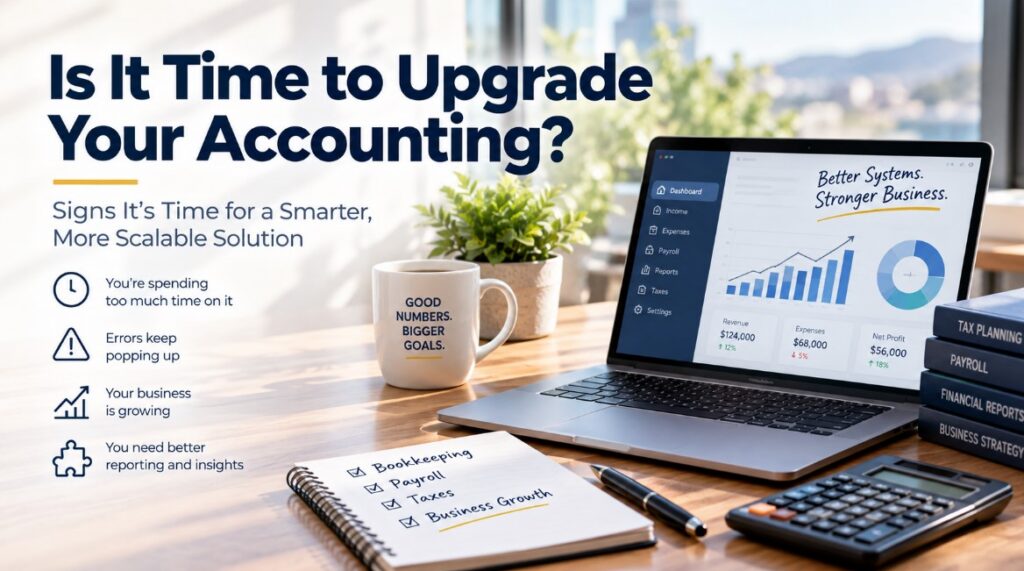
The bookkeeping setup that carried you through your first couple of years often stops keeping up once the business grows. A few signals that you have outgrown it:
- Your books only get touched before a tax filing, so you spend most of the year flying blind.
- You run payroll across a few spreadsheets and hope the withholdings and deposits are right.
- You cannot answer “did we make money last month” without an afternoon of digging.
- Reconciling the bank account happens once a year, if at all.
- The person keeping the books is you, at 10 p.m. on a Sunday.
Upgrading is not really about buying newer software. It is about having a repeatable monthly close, one person accountable for it, and clean financial reporting you can trust. For a lot of the businesses we work with in the Twin Cities, from auto repair shops to dental practices to the building trades, that also means handling seasonal swings in income without the books falling behind.
That can look like a proper QuickBooks setup run by certified ProAdvisors, moving your books to outsourced bookkeeping so it gets done on a schedule, or building out full small business accounting with monthly reporting and advisory built in. The point is to stop reacting and start running on a system.
Why record-keeping shouldn’t wait until tax season
Organized records are not a March project. The work you skip during the year is exactly the work that turns into a scramble when returns are due, and it is usually where deductions get lost.
A few habits do most of the heavy lifting:
- Keep a dedicated business bank account and card. Mixing personal and business spending is the single most common reason a set of books takes hours to untangle later.
- Reconcile monthly instead of annually, so errors get caught while you still remember the transaction.
- Save digital copies of receipts, invoices, mileage logs, and payroll records as you go.
There is a compliance reason too. When you claim a deduction, the burden of proof is on you to substantiate it, and the IRS generally expects you to keep supporting records for three years, with employment tax records held for at least four. Records you cannot produce are deductions you cannot safely take.
Staying organized year round means faster tax preparation, fewer surprises, and a real shot at every deduction you have earned. It is far cheaper to keep the books clean than to rebuild them under a deadline.
Get bookkeeping, payroll, and tax under one roof
Corneliuson & Associates has helped Twin Cities small businesses build accounting systems that scale since 1998. Tell us where things stand, and we’ll show you what an upgrade looks like for your business.
How to read your profit and loss statement
Your profit and loss statement (also called an income statement) is the report that shows what your business earned and spent over a period. At its simplest: revenue, minus cost of goods sold, gives you gross profit. Subtract operating expenses and you have net profit. Most owners glance at the bottom line and stop there, which is where the useful information gets left on the table.
Read it as a trend across months, not a single snapshot, and watch three things:
- Gross margin slipping. If revenue climbs but gross profit stays flat, your direct costs are creeping up. This shows up constantly in trades and restaurants that have not repriced against rising material or labor costs. It is a signal to raise prices or tighten sourcing before it eats your year.
- An expense line outrunning revenue. Software subscriptions, merchant processing fees, and contractor labor tend to grow quietly. Compare each major expense to revenue over time, not just to last month.
- Profit on paper but no cash in the bank. Net profit is not the same as cash. If your P&L looks healthy but the account is tight, the money is usually tied up in unpaid invoices or inventory. That is why owners pair the P&L with a look at cash flow.
Fifteen minutes with your P&L each month tells you where to raise prices, where to cut, and whether growth is actually paying off. Reports are only useful if someone helps you read them, which is a large part of what monthly accounting should include.
Frequently asked questions
How often should a small business review its profit and loss statement?
Monthly. A monthly review lets you catch margin problems and expense creep early, while there is still time to act. Waiting until tax season means you find out about a bad trend nine months after it started.
What is the difference between bookkeeping and accounting?
Bookkeeping is the day-to-day recording of transactions and reconciling accounts. Accounting builds on that to produce financial statements, interpret the numbers, and support tax and planning decisions. Most growing businesses need both.
How long do I need to keep my business records?
The IRS generally recommends keeping records for three years, with employment tax records held for at least four. Some documents, like those tied to property or assets, should be kept longer. When in doubt, keep it.
When should a small business outsource its bookkeeping?
A common trigger is when the owner is spending nights and weekends on the books, when the monthly close is consistently late, or when payroll and reporting have gotten too complex to run reliably in spreadsheets.
Do I need a CPA, or is a bookkeeper enough?
It depends on the work. A bookkeeper can handle recording and reconciling. For tax planning, financial strategy, and complex filings, you want CPA-level oversight. A firm that offers both under one roof keeps everything consistent.
Get a system in place
If your books only come out at tax time, or you are not sure what your P&L is telling you, that is worth fixing before it costs you a deduction or a decision. Our team helps Minnesota and western Wisconsin small business owners put bookkeeping, payroll, and tax on a reliable monthly system, with a CPA-led firm behind it.
Schedule a call to talk through where your accounting stands.
